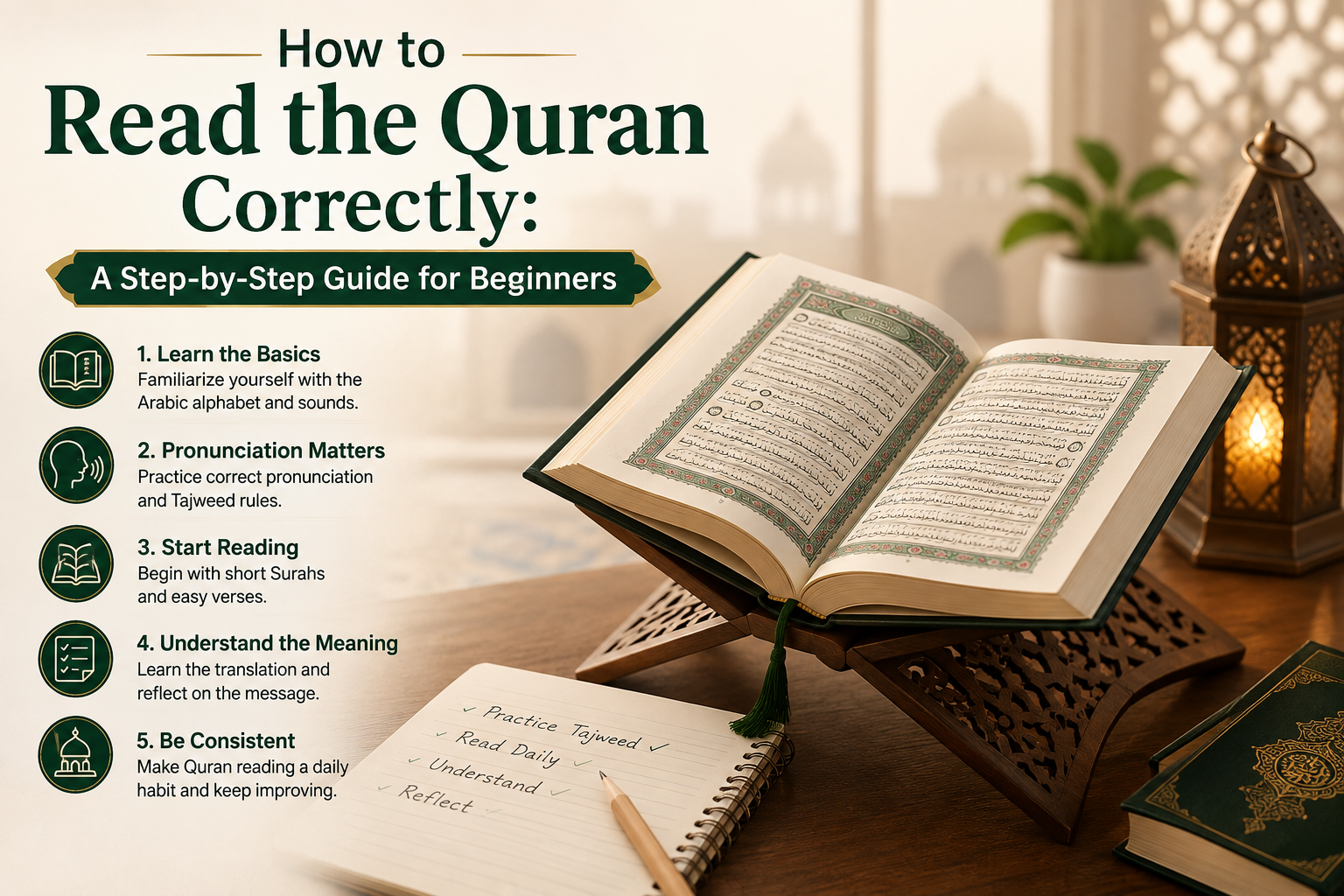
Learning to read the Quran is one of the most meaningful journeys a Muslim can undertake. Yet for many beginners, whether children, new Muslims, or adults who never had the chance to learn as kids, the Arabic script, unfamiliar sounds, and rules of Tajweed can feel overwhelming at first. The good news is that with the right approach, consistency, and guidance, anyone can learn to read the Quran correctly, regardless of age or background.
This step-by-step guide walks you through exactly how to start, what to focus on at each stage, and the common mistakes to avoid. If you prefer structured, guided learning rather than figuring it out alone, enrolling in a proper Quran memorization course can significantly speed up your progress by pairing you with a qualified teacher who corrects your pronunciation in real time.
Why Reading the Quran Correctly Matters
Before diving into the steps, it’s worth understanding why “correct” reading matters so much in Islam. The Quran was revealed in Arabic, and its meaning, rhythm, and spiritual impact are tied closely to how it is pronounced. A single mispronounced letter can sometimes change the meaning of a word entirely. This is why Muslims are encouraged to learn Tajweed, the set of rules governing correct pronunciation, rather than simply reading the Arabic letters as they would in casual speech.
Beyond meaning, there’s also a spiritual dimension. The Prophet Muhammad (peace be upon him) encouraged believers to recite the Quran beautifully and correctly, and doing so is considered an act of worship in itself, separate from simply understanding the content.
Step 1: Learn the Arabic Alphabet First
You cannot read the Quran without first knowing the 28 letters of the Arabic alphabet. Unlike English, Arabic is read from right to left, and many letters change shape depending on their position in a word (beginning, middle, or end).
Start here:
- Learn to recognize each letter in isolation.
- Practice identifying the same letter in its different forms (initial, medial, final, and standalone).
- Focus on correct pronunciation, many Arabic letters have no equivalent sound in English, such as ع (Ayn), ح (Haa), and ق (Qaaf).
Spend time listening to a native Arabic speaker or qualified teacher pronounce each letter, and repeat after them. This is one area where self-study from books alone often falls short, since subtle pronunciation errors are hard to catch on your own.
Step 2: Understand Arabic Vowel Marks (Harakat)
Once you’re comfortable with the letters, the next step is learning the vowel marks, known as Harakat. These are the small symbols placed above or below letters that indicate short vowel sounds:
- Fatha (َ ) – a short “a” sound
- Kasra (ِ ) – a short “i” sound
- Damma (ُ ) – a short “u” sound
- Sukoon (ْ ) – indicates no vowel sound (the letter is “silent” in terms of vowel)
- Shaddah (ّ ) – doubles the letter’s sound
Practice combining letters with these marks to form simple syllables, then short words. This stage is foundational, rushing through it often leads to reading difficulties later on.
Step 3: Start with Noorani Qaida
The Noorani Qaida is a traditional beginner’s book used across the Muslim world to teach children and adults how to read Arabic before moving to the Quran itself. It systematically introduces:
- Individual letters and their sounds
- Joined letters and how words are formed
- Basic Tajweed rules in a simplified format
- Practice exercises building up to full verses
Most reputable Quran teachers insist beginners complete the Noorani Qaida before starting on the Quran directly, since it builds the reading fluency needed to avoid developing bad habits.
Step 4: Learn the Basics of Tajweed
Tajweed refers to the rules of correct Quranic pronunciation and recitation. While mastering Tajweed fully takes years, beginners should learn the foundational rules early on, including:
- Makhraj (articulation points): where each letter’s sound originates in the mouth or throat
- Noon Sakinah and Tanween rules: how these sounds change based on the letter that follows
- Meem Sakinah rules: similar rules specific to the letter Meem
- Madd (elongation): which letters and situations require stretching the sound, and for how long
- Qalqalah: the slight bouncing/echoing sound applied to specific letters
Learning Tajweed alongside reading practice, rather than reading first and adding Tajweed later, helps beginners build correct habits from the start rather than having to “unlearn” incorrect pronunciation.
Step 5: Practice with Short Surahs First
Once you’ve built a foundation, begin practicing with the shorter surahs found in the last part (Juz Amma) of the Quran, such as:
- Surah Al-Fatiha
- Surah Al-Ikhlas
- Surah Al-Falaq
- Surah An-Nas
- Surah Al-Kawthar
These surahs are short, commonly memorized early, and give beginners a manageable way to apply what they’ve learned about letters, vowels, and Tajweed rules in real Quranic text.
Step 6: Read Slowly and Focus on Accuracy Over Speed
One of the most common mistakes beginners make is trying to read quickly before they’re ready. Correct reading requires:
- Pausing at the right places (waqf)
- Applying elongation rules accurately
- Pronouncing each letter from its correct articulation point
- Reading with a calm, measured pace (tarteel)
Speed will naturally come with time and practice. Prioritizing accuracy from the beginning prevents habits that are difficult to correct later.
Step 7: Listen to Qualified Reciters Regularly
Listening to skilled Quran reciters is one of the most effective ways to internalize correct pronunciation and rhythm. Choose reciters known for clear, measured recitation (often labeled “Murattal” style, which is slower and clearer than performance-style recitation) and listen while following along with the Arabic text in front of you. Over time, this trains your ear to recognize correct sounds and rhythms, even before you fully understand the underlying Tajweed rules.
Step 8: Get Feedback from a Qualified Teacher
Self-study can only take you so far. Because many Arabic sounds and Tajweed rules are difficult to self-correct, working with a knowledgeable teacher, whether in person or online, is essential for catching mistakes you can’t hear yourself. A good teacher will:
- Listen to your recitation and correct pronunciation errors immediately
- Ensure you’re applying Tajweed rules correctly, not just reading fluently
- Track your progress and gradually introduce more complex surahs
- Provide accountability and structure, which is often the biggest challenge for self-learners
This is where working with an established institution makes a real difference. Shaikh Saleh Academy offers structured, one-on-one guidance for learners at every level, ensuring that beginners build correct habits from day one rather than having to relearn things later.
Step 9: Be Consistent
Progress in Quran reading comes from regular, even if short, daily practice — not occasional long sessions. Aim for:
- 15–20 minutes of daily practice, minimum
- Reviewing previously learned surahs regularly to retain them
- Setting small, achievable weekly goals (e.g., mastering one new rule or surah per week)
Consistency matters far more than intensity. A beginner who practices 15 minutes daily will typically progress faster than one who studies for two hours once a week.
Common Mistakes Beginners Should Avoid
- Skipping the Noorani Qaida and jumping straight into the Quran
- Reading too fast before mastering basic pronunciation
- Ignoring Tajweed rules in the early stages, assuming they can be added later
- Learning without feedback, which allows errors to go uncorrected for months or years
- Inconsistent practice, leading to forgetting what was previously learned
Final Thoughts
Learning to read the Quran correctly is a gradual process built on strong fundamentals: mastering the Arabic alphabet, understanding vowel marks, working through the Noorani Qaida, applying Tajweed rules, and practicing consistently with feedback from a qualified teacher. There is no shortcut that replaces steady, guided practice, but with the right structure and patience, every beginner can reach a stage of confident, correct recitation.